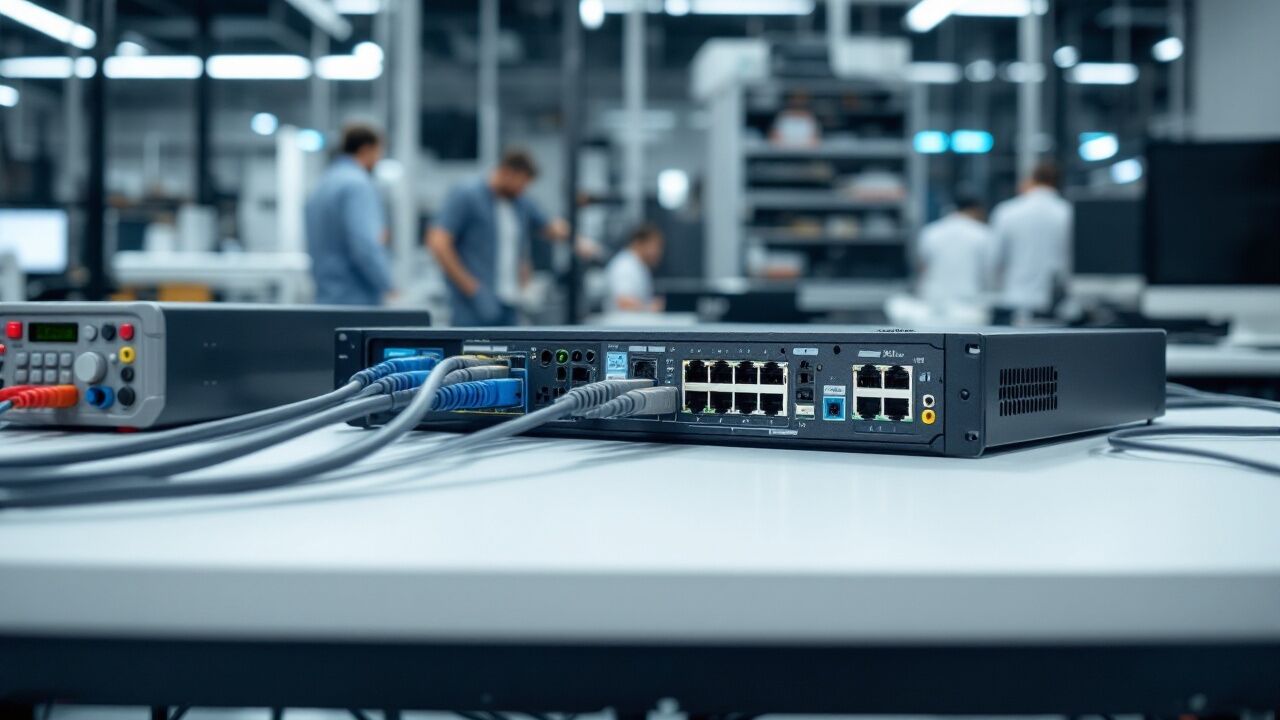

Somewhere in most companies there's a shelf (or a cage, or a whole storeroom) of decommissioned network gear waiting for someone to decide what it is: an asset or a liability. It's both, and the difference is process. Done right, a decommissioning recovers real budget. Done casually, it recovers pennies and leaves your configs on a switch someone buys at auction. Here's the 2026 playbook.
What retired gear is actually worth
Enterprise network hardware holds value far longer than most IT assets. The demand comes from budget-constrained buyers, lab and test environments, spares pools, and, importantly, other enterprises running the same platform who need to feed an installed base for years.
The strongest resale demand in 2026 sits with mainstream platforms one to two generations back: early Catalyst 9300 SKUs, the enormous Catalyst 2960-X installed base, Nexus 9300-EX/FX data-center switches, Juniper EX4300/EX4600 and QFX5100, and Arista 7050X/7280R series. One market wrinkle worth knowing: since HPE completed its $14 billion acquisition of Juniper Networks on July 2, 2025, product-line consolidation questions have hung over the combined portfolio, and in our experience, roadmap uncertainty tends to *increase* secondary-market demand for proven platforms, as buyers hedge with hardware they already trust.
Timing beats negotiating
Resale value doesn't decay smoothly. It steps down at two lifecycle events:
- End-of-sale. When a platform leaves the price list, refresh waves push supply into the market and prices step down.
- Last date of support (LDoS). When OEM support ends, every buyer who needs a support contract exits the market at once, and value steps down again, usually for good.
The practical rule: sell before the LDoS, not after. Catalyst 2960-X hits its last date of support in October 2027; units sold today command meaningfully more than the same units will in eighteen months. Gear you pulled during a migration and shelved "just in case" is quietly depreciating while it waits for a decision.
Data sanitization is not optional
Switches and routers carry more than most people remember: running and startup configs, VLAN maps, SNMP strings, RADIUS/TACACS+ secrets, certificates, and stored credentials. Newer platforms with SSDs also hold logs and archived configs. Before any unit leaves your custody:
- Follow a recognized standard. NIST SP 800-88 (Guidelines for Media Sanitization, refreshed as Revision 2 in September 2025) is the canonical reference, and it points to IEEE 2883-2022 for current media-specific techniques; both are increasingly cited in ITAD contracts. For network devices, that means wiping configurations, clearing NVRAM and flash, and erasing or removing any internal storage. Cisco's own "factory-reset all secure" command on Catalyst 9K, for example, implements the NIST purge level.
- Release the licenses. Unclaim smart licenses and transferable entitlements from your portal accounts before the hardware ships. It protects you and preserves value for the next deployment.
- Demand paper. A serialized certificate of data sanitization for every unit, tied to a documented chain of custody from your dock to the buyer's facility. If a buyer can't produce that paperwork, they're not an IT asset disposition partner; they're a scrapper with a website.
- Check certifications where destruction is involved. R2v3, which has fully replaced the legacy R2:2013 standard, and e-Stewards are the two recognized ITAD certification schemes. Any partner still citing R2:2013 hasn't been audited in years.
Reuse is the best environmental outcome
The UN's Global E-waste Monitor puts global e-waste at 62 million tonnes in 2022, heading for 82 million tonnes by 2030, with only 22.3% formally collected and recycled. Resale into a second production life beats even certified recycling on every environmental measure: the embodied carbon of manufacturing is only amortized by use. If your company reports on sustainability, documented hardware reuse is a line item worth claiming.
What the process should look like
A competent buyer makes this short: you send a manifest (model numbers, quantities, condition), you get a real offer with per-line pricing, logistics get arranged (palletized pickup for rack-scale lots) and payment lands promptly after receipt and verification, not "net-whenever."
Two things make an offer materially better, and both are in your control. First, the manifest: exact model numbers (the sticker, not the memory), quantities, whether original power supplies and modules are included, and honest condition notes: "pulled working, rack rash" prices better than a mystery pallet, because the buyer prices uncertainty against you. Second, completeness: switches with their power supplies, fan trays, and installed modules are worth more than bare chassis and a box of loose parts. Ten minutes with a label printer during the decommission pays for itself at the offer stage.
That's how we run it. Sell your gear to Townsend Networks: send the list, get an offer, and we arrange pickup. Units are verified and processed within 48 hours of arrival, with payment by check, wire, or trade-in credit toward tested replacement hardware. Twenty-plus years of buying and refurbishing means we know what your equipment is worth, and we're the ones putting it through our own testing process, not flipping it blind.
Racks coming out this quarter? Get an offer before the market steps down, or request a quote if the same project needs replacement hardware on the way in.
Sources
- Cisco End-of-Sale and End-of-Life products portal: Catalyst 2960-X notices and Catalyst 9K factory-reset documentation
- HPE press release: completion of the Juniper Networks acquisition, July 2, 2025 (SEC exhibit)
- NIST SP 800-88 Rev. 2: Guidelines for Media Sanitization (September 2025)
- IEEE 2883-2022: Standard for Sanitizing Storage
- SERI: the R2v3 responsible recycling standard
- UN Global E-waste Monitor 2024 (ITU/UNITAR)