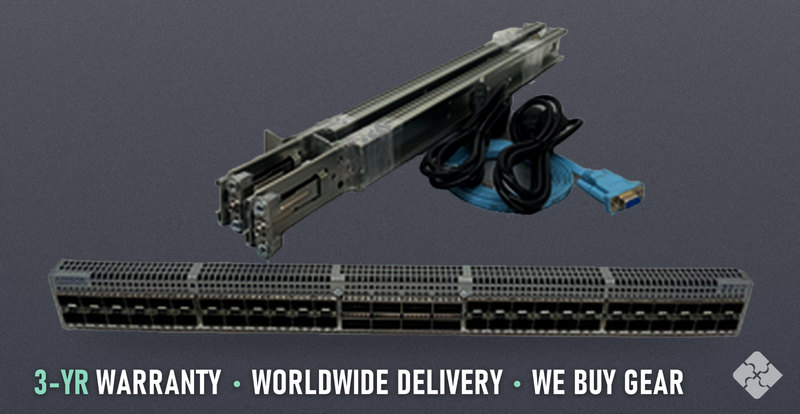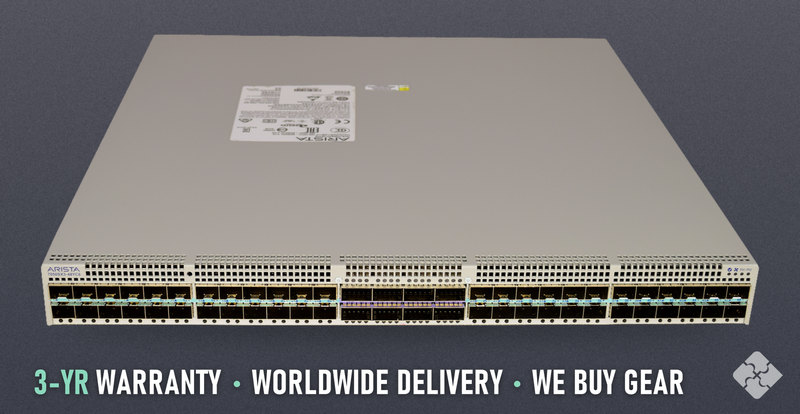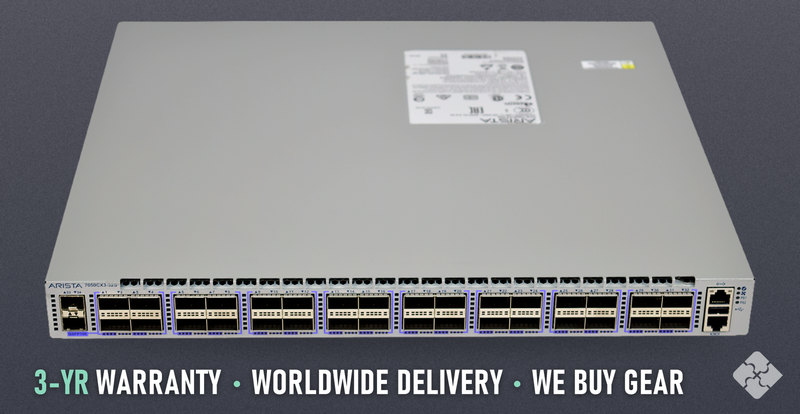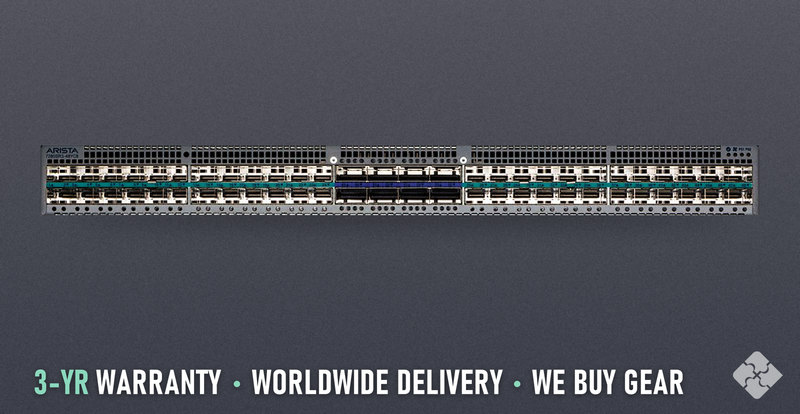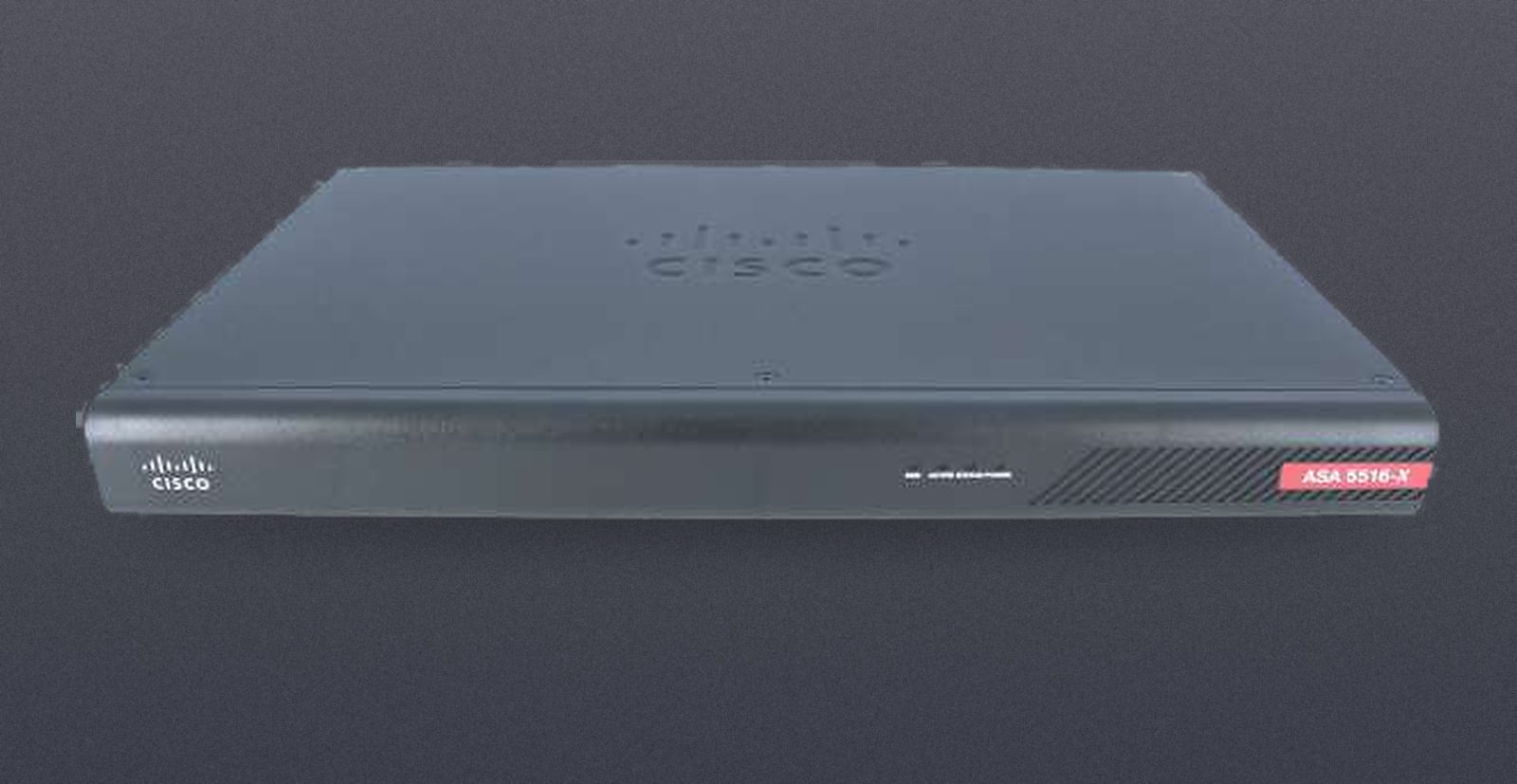
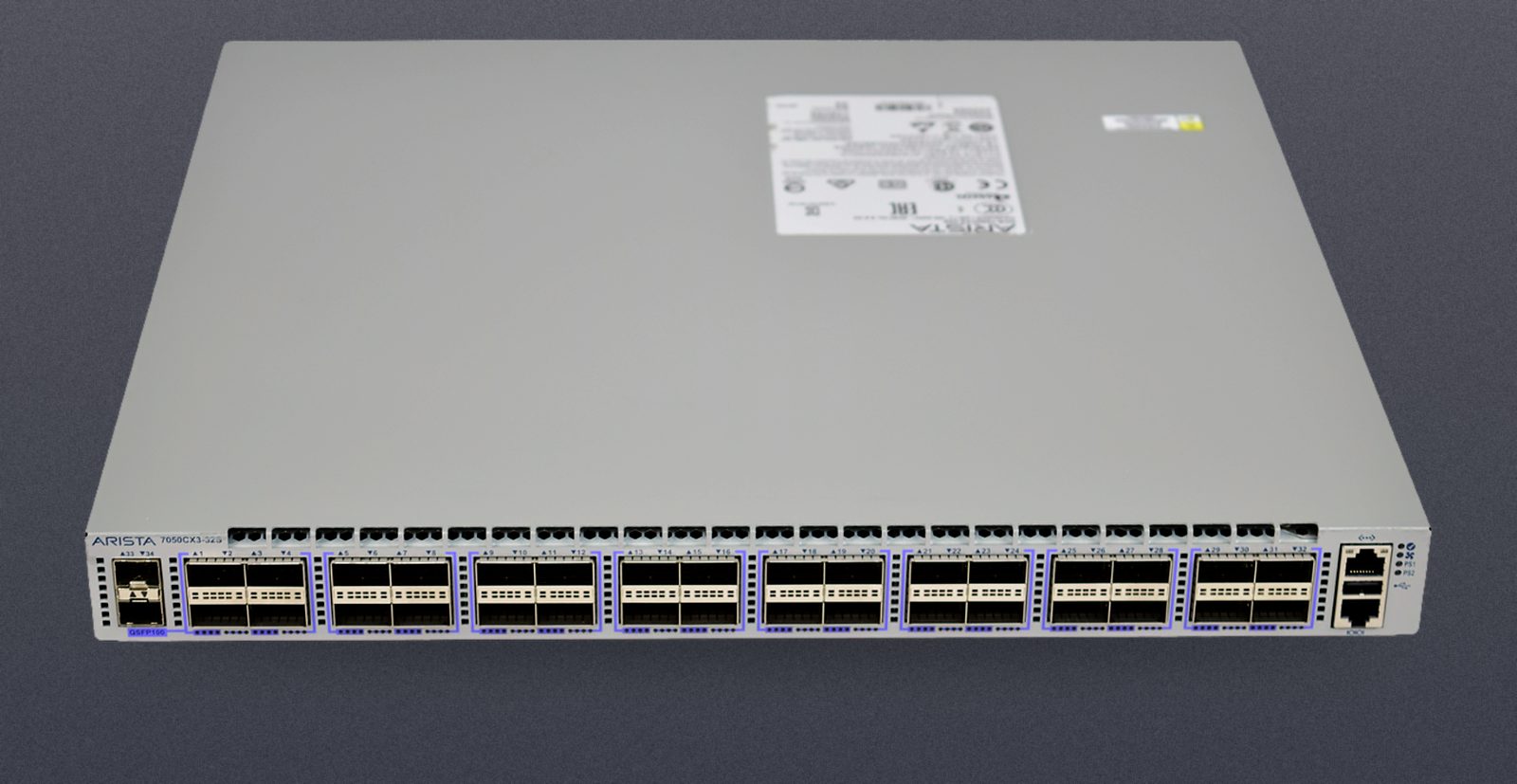
Two Arista families get mixed up because their part numbers look alike. The DCS-7050SX3-48YC8 and the DCS-7280SR3-48YC8 are both 1RU switches with 48 SFP ports that run 1G, 10G or 25G and 8 QSFP100 uplinks, and both run Arista EOS. What differs is inside: the buffer, the route table and the job each one is built for. This guide reads both families from Arista's own data sheets, linked under Sources at the end.
Same layout, different switch
| DCS-7050SX3-48YC8 | DCS-7280SR3-48YC8 | |
|---|---|---|
| Ports | 48 x SFP (1/10/25G), 8 x QSFP100 | 48 x SFP (1/10/25G), 8 x QSFP100 |
| Throughput | 2 Tbps each way, 4 Tbps both ways | 2 Tbps each way, 4 Tbps both ways |
| Packets per second | 1 billion | 1 billion |
| Latency | From 800 ns | From 3.8 us |
| Packet buffer | 32 MB, shared | 4GB, with virtual output queues |
| Routes | 360K IPv4 routes, 288K MAC entries (series) | Over 2 million IPv4 unicast routes, 384K MAC addresses (series) |
| Power, typical and maximum | 124 W, 301 W | 154 W, 324 W |
| Built for | Leaf and top of rack, fixed spine | Internet peering, interconnect, carrier edge |
Power is typical and maximum as Arista lists them, with typical measured at 25 C ambient and half load on every port. The 7280R3 series data sheet lists the deep buffer as up to 16GB across the series, and the large route models (the K in the part number) as over 5 million IPv4 routes.
The 7050X3 family
The 7050X3 is Arista's 10, 25, 40, 50 and 100G data center line. Every model has the same forwarding design: cut-through latency from 800 ns, a 32 MB shared buffer, 1+1 hot-swap power supplies and N+1 fans. Read 48YC8 as 48 ports of 25G SFP and 8 ports of 100G QSFP, the way Arista's model overview describes it.
| Model | Ports | Throughput, each way |
|---|---|---|
| 7050CX3-32S, 7050CX3-32C | 32 x 100G QSFP100 and 2 x SFP+ | 3.2 Tbps |
| 7050SX3-48YC8, 7050SX3-48YC8C | 48 x 25G SFP and 8 x 100G QSFP100 | 2 Tbps |
| 7050SX3-48YC12 | 48 x 25G SFP and 12 x 100G QSFP100 | 2.4 Tbps |
| 7050SX3-96YC8 (2RU) | 96 x 25G SFP and 8 x 100G QSFP100 | 3.2 Tbps |
| 7050SX3-48C8, 7050SX3-48C8C | 48 x 10G SFP+ and 8 x 100G QSFP100 | 1.28 Tbps |
| 7050TX3-48C8 | 48 x 10GBASE-T (1, 2.5, 5 or 10G) and 8 x 100G QSFP100 | 1.28 Tbps |
On the 48YC8 the QSFP100 ports run 100GbE or 40GbE. On the 48YC12, the 96YC8 and the CX3 models they also break out to 4x10G, 4x25G or 2x50G.
Arista has set end of sale dates on part of the family. The DCS-7050SX3-48YC8 and DCS-7050SX3-48C8 stop selling on December 31, 2026, with support to December 31, 2031, and Arista names the 48YC8C and 48C8C as the replacements. The DCS-7050CX3-32S ended sale on March 20, 2026 with support to March 20, 2031, and Arista names the DCS-7050CX3-32C. See Arista 7050SX3-48YC8 End of Sale for the notice.
The 7280R3 family
The 7280R3 is a router in switch form. Its deep packet buffer uses virtual output queues so that traffic bursts do not block other flows, and Arista says its FlexRoute engine supports the full internet routing table in hardware. Arista lists internet peering, carrier edge VPN services, EVPN, MPLS and segment routing cores, and 5G timing among its jobs.
| Model | Ports | Wire speed, each way | Buffer |
|---|---|---|---|
| 7280SR3-40YC6 | 40 x 25G SFP and 6 x 100G QSFP | 800 Gbps | 2GB |
| 7280SR3-48YC8 | 48 x 25G SFP and 8 x 100G QSFP | 2 Tbps | 4GB |
| 7280CR3-36S | 36 x 100G QSFP, with 200G and 400G flexibility | 2.4 Tbps | 4GB |
| 7280CR3-32P4 | 32 x 100G QSFP and 4 x 400G OSFP | 4.8 Tbps | 8GB |
| 7280CR3-32D4 | 32 x 100G QSFP and 4 x 400G QSFP-DD | 4.8 Tbps | 8GB |
| 7280PR3-24 | 24 x 400G OSFP | 9.6 Tbps | 16GB |
| 7280DR3-24 | 24 x 400G QSFP-DD | 9.6 Tbps | 16GB |
| 7280CR3-96 | 96 x 100G QSFP | 9.6 Tbps | 16GB |
Three letters change what you are buying. A K (7280CR3K, 7280SR3K) marks the large route version. Arista's data sheet lists MACsec on the M and MK models. And on the 400G models the connector matters: OSFP and QSFP-DD optics do not fit each other's cages, so the P4 and D4 versions need different transceivers.
Arista ended sale of the 7280SR3K-48YC8 on October 10, 2026, with support to October 10, 2031, and names the 7280SR3K-48YC8A as the replacement.
How to choose
- Server leaf at 10G or 25G with 100G uplinks, inside one data center: the 7050X3. Low latency is what it is for.
- Internet edge, peering, data center interconnect or a large route table: the 7280R3, with a K model when the table is large.
- 400G ports: the 7280R3. The 7050X3 tops out at 100G.
- A fleet you already run: stay in the family. One EOS image, one set of optics and one spares pool is worth more than a small gain from a mixed rack.
Do not swap the two because the port layout matches. A design that leans on deep buffers or route scale will not behave the same on a 7050X3.
Reading the rest of the part number
The ending -F or -R names the airflow. Arista's 7280R3 ordering table defines front to rear as air flowing from the port side to the fan side, and rear to front the other way. Fans and power supplies must all match the switch. A number that ends in a hash instead is sold with configurable fans and power supplies. The full table is in airflow suffixes.
Buying used or open box: what to check
- Airflow. Match -F or -R to the cold aisle before you order.
- Optics. The 48C8 models take SFP+ in their small ports and the 48YC8 models take SFP28, which also runs 10G and 1G. On a 7280CR3 400G model, confirm OSFP or QSFP-DD.
- Route scale. For peering, confirm a K model.
- End of sale. An end of sale date closes the maker's order book and does not stop a switch working. After the date, a matching unit comes from used or open box stock. The articles for the 7060CX and 7060SX2 and the 7050SX3 carry the notices.
Where to look
The Arista 7050X3 page and the Arista 7280 page hold the families, and the Arista brand guide covers the rest. In stock now: the DCS-7050SX3-48YC8-F, the DCS-7050SX3-48YC8-R, the DCS-7050CX3-32S-F, the DCS-7280SR3-48YC8-R, the DCS-7280SR3-48YC8-F and the DCS-7280CR3K-32D4-F. Each page states its condition. The older comparison Arista DCS7050CX3 vs DCS7050SX3 sets the 7050CX3 beside the 7050SX3. For another part number, request a quote.
Sources
- Arista 7050X3 Series data sheet, Arista
- Arista 7280R3 Series data sheet, Arista
- End of sale of the 7050SX3-48YC8 and 7050SX3-48C8 series, Arista notice 24134
- End of sale of the 7050CX3-32S switches, Arista notice 22419
- End of sale of the 7280SR3K-48YC8 series, Arista notice 23789