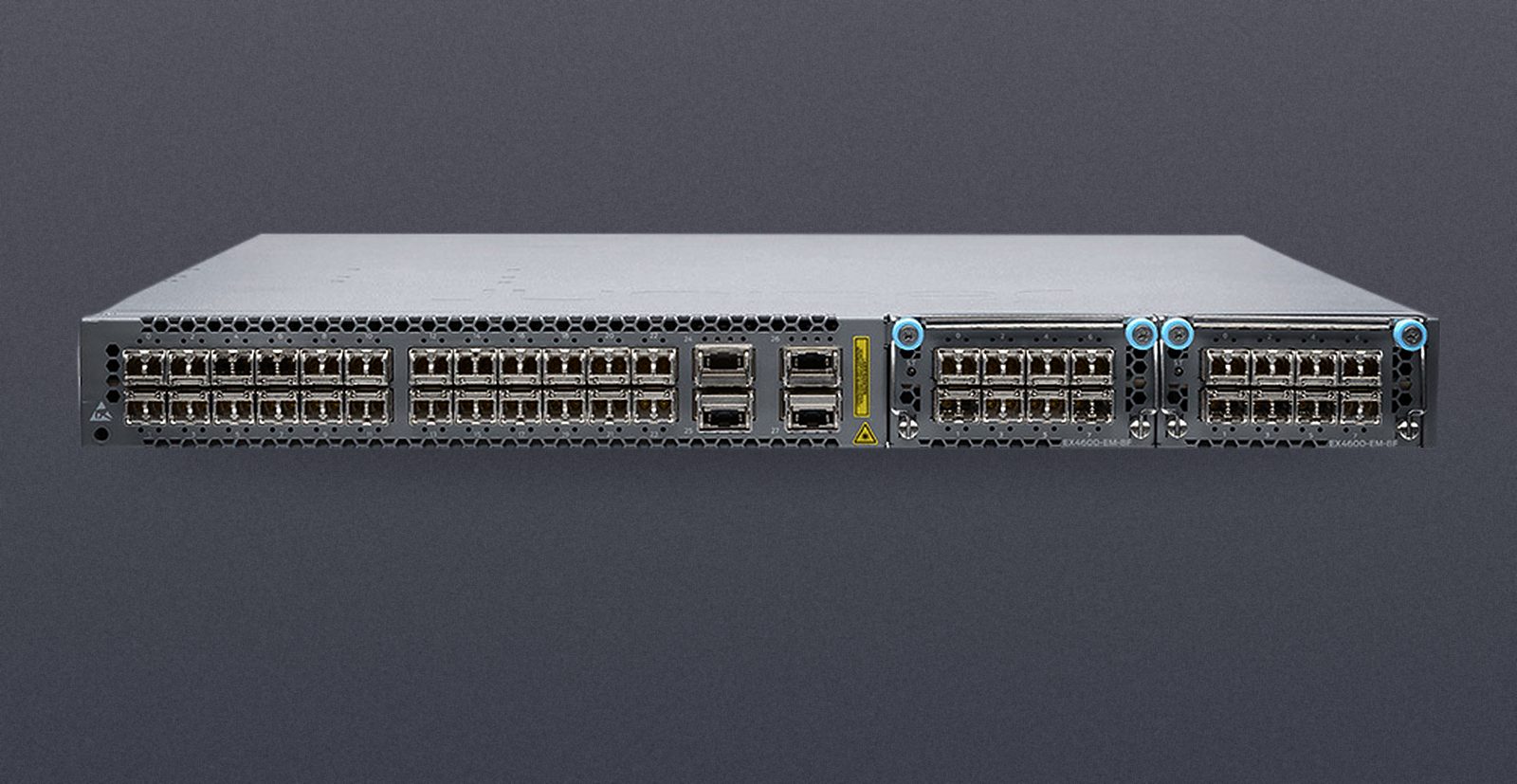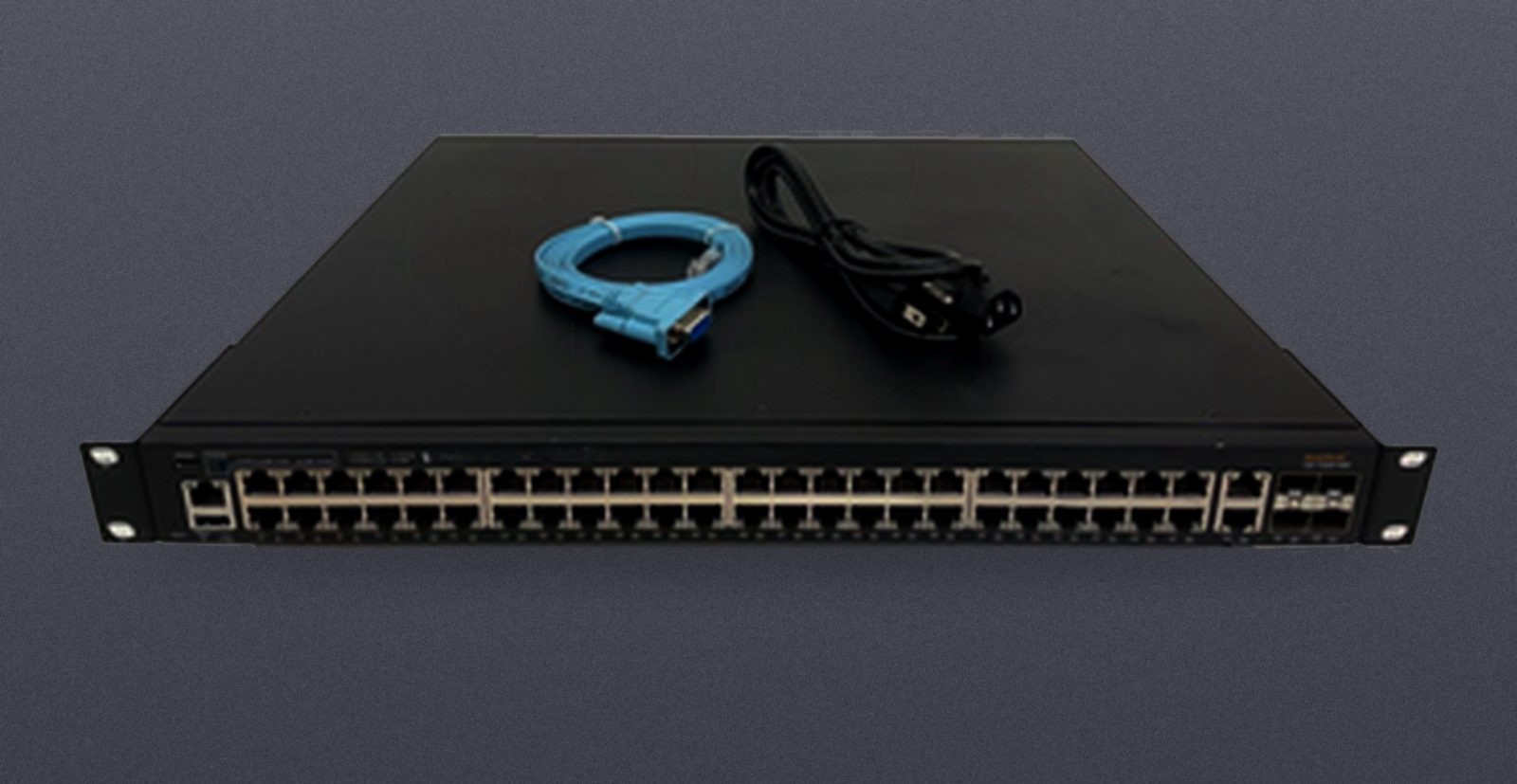
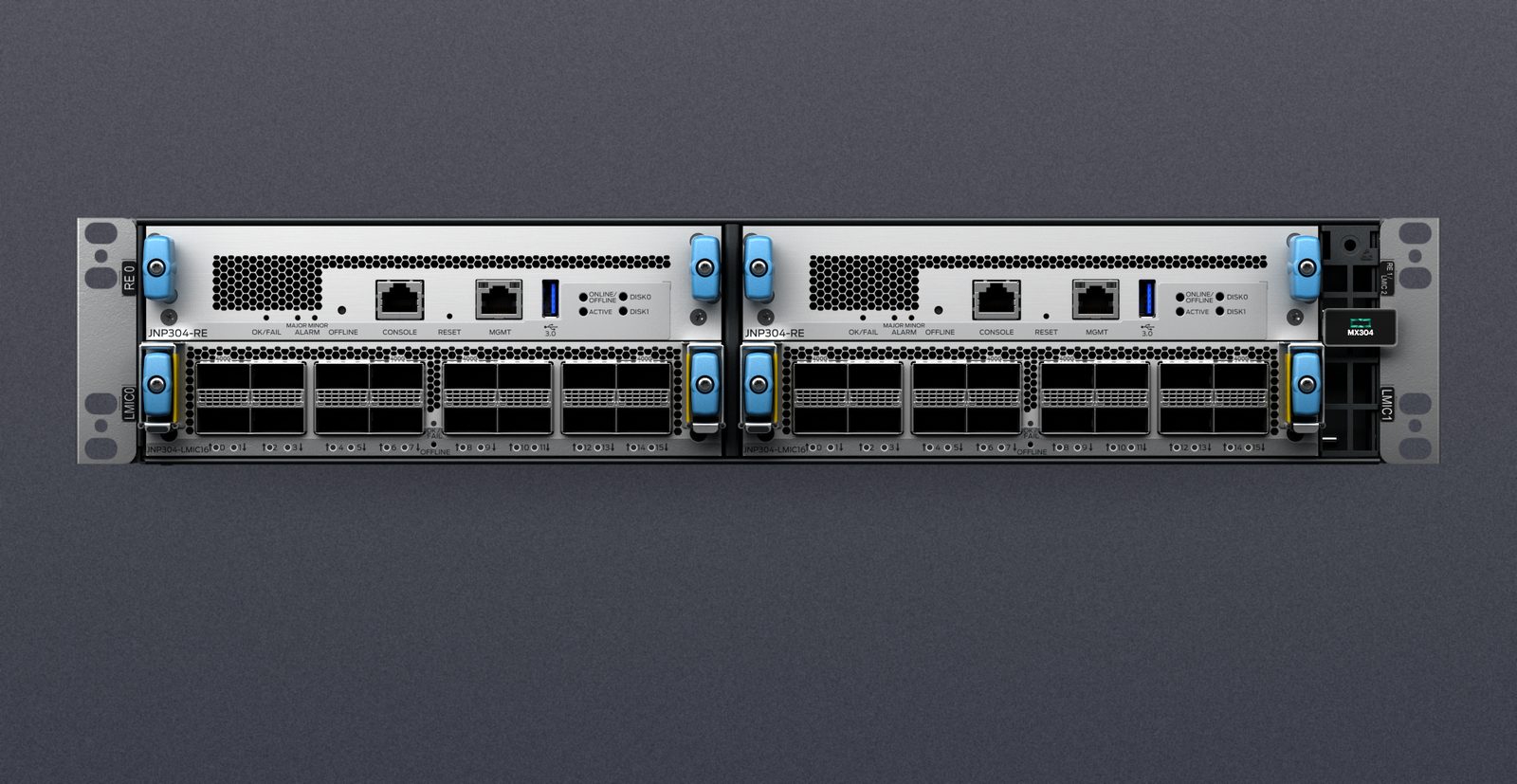
The MX204 and the MX304 sit at the small end of Juniper's MX Series, and they get compared constantly because both fit where a full MX480 or MX960 chassis would be overkill. They are not two sizes of the same box. One is a fixed router you install and forget; the other is a small modular chassis you grow into. The specifications below come from Juniper's own pages: the MX204 specifications, the MX204 router overview and the MX304 specifications.
At a glance
| MX204 | MX304 | |
|---|---|---|
| System capacity | 400 Gbps | 4.8 Tbps |
| Height | 1U | 2U |
| Ports | 4 rate-selectable (100GbE, 40GbE or 4x10GbE) plus 8 x 10GbE SFP+ | Set by the line-card modules (LMICs) installed |
| Routing engines | One, built in | One RE with 3 LMICs, or two REs (redundant) with 2 LMICs |
| Power | 100-240 V AC or -40 to -72 V DC | 100-240 V AC, -48 V DC, or high-voltage AC/DC |
| Depth and weight | 18.7 in, up to 23.15 lb | 24 in, 66.1 lb with two REs |
| Operating temperature | 0 to 55 °C | 0 to 46 °C |
The MX204: a fixed 1U edge router
The MX204 is one rack unit with everything built in. Its four rate-selectable ports take QSFP28 or QSFP+ optics and run as 100GbE or 40GbE, or as four 10GbE ports each with a breakout cable. Eight more ports take 10GbE SFP+ optics. Forwarding runs on Juniper's Trio chipset. Juniper lists its uses as high-speed transport and VPN services, broadband multiplay services, and data center internetworking.
What it does not have: a second routing engine, or any way to add ports. It has two power supplies and three fan modules, so power and cooling are redundant, but the routing engine is not.
Buy the MX204 when:
- four 100GbE uplinks and eight 10GbE ports cover the site;
- 400 Gbps of total capacity is enough for the next few years;
- rack space and power are tight (1U, 18.7 in deep);
- a single routing engine is acceptable, or you will run two MX204s as a pair.
The MX304: a 2U modular chassis
The MX304 is two rack units with 4.8 Tbps of capacity, twelve times the MX204's. Ports come from line-card modules called LMICs. The MX304-LMIC16-BASE carries 16 ports of 100GbE, four of which also run at 400GbE. The chassis takes one routing engine and three LMICs, or two routing engines and two LMICs, which is the configuration to choose when the router cannot go down for a routing-engine failure. Besides standard AC and -48 V DC, it accepts high-voltage AC and DC feeds.
Buy the MX304 when:
- you need 400GbE ports, which the MX204 cannot provide;
- traffic will outgrow 400 Gbps;
- routing-engine redundancy is a requirement;
- you want to add capacity later by adding an LMIC rather than replacing the router.
Buying either one refurbished: what to check
- What is in the box. An MX304 listing can mean a bare chassis, a base system, or a premium system with two routing engines; check how many REs and LMICs are installed. On an MX204, check whether it comes with AC or DC power supplies.
- Power supplies. AC and DC units are different parts. Match them to the rack before ordering.
- Optics. Transceivers are usually sold separately. The MX204 needs QSFP28 or QSFP+ for the four large ports and SFP+ for the eight 10GbE ports; 400GbE on the MX304 needs QSFP-DD.
- Software licence. Ask what licence the unit carries and what transfers with it before you plan features around it.
- Rack depth. The MX304 is 24 in deep, more than five inches deeper than the MX204.
Where to look
Townsend stocks both families: see the MX204 range and the MX304 range, including the MX304 base system, the MX304 premium system and the MX304-LMIC16-BASE line card. Every unit is tested before it ships and carries a 3-year warranty. Not sure which fits? Send us the requirement and a technician will answer.