Juniper's MX Series runs from a 2U router with four 10GbE ports built in to a 16U chassis that holds line cards and redundant control boards. This guide sets the compact models, the MX40, MX80 and MX104, next to the chassis models, the MX240, MX480 and MX960, and covers the line cards and Routing Engines the chassis share. Every figure comes from Juniper's hardware guides, datasheet and end of life pages, listed under Sources.
The short answer
Buy an MX80 or an MX104 when the site needs a handful of 10GbE ports and a few interface modules in little rack space. The MX80 is 2U with four 10GbE XFP ports built in; the MX104 is 3.5U with four 10GbE SFP+ ports built in, four MIC slots and a temperature rating for harsh sites. Buy an MX240, MX480 or MX960 when the site needs line cards. The MX240 has room for up to three in 5U, the MX480 has 8 slots in 8U, and the MX960 is a 16U chassis. The chassis are also where redundant Routing Engines and switch control boards live.
The models side by side
| Model | Size | Ports built in | Slots | Capacity |
|---|---|---|---|---|
| MX40 | 2U | Ports 0 and 1 of the 4 x 10GbE XFP MIC | Front MIC slots | 60 Gbps |
| MX80 | 2U | 4 x 10GbE XFP | 2 front MIC slots, 1 rear Multiservices MIC slot | 20 to 80 Gbps by license |
| MX104 | 3.5U | 4 x 10GbE SFP+ | 4 MIC slots | 80 Gbps |
| MX240 | 5U | None | 2 line card slots, 1 multifunction slot, 1 SCB slot | Up to 1.92 Tbps of fabric |
| MX480 | 8U | None | 8 slots | Up to 5.76 Tbps of fabric |
| MX960 | 16U | None | Line card and control board slots | Up to 160 Gbps per slot with the SCB-MX960-S |
The compact routers: MX40, MX80 and MX104
The MX40 and the MX80 are the same 2U chassis. Juniper's hardware guide covers the MX5, MX10, MX40 and MX80 together: capacity is software upgradeable from 20 Gbps to 80 Gbps, and the license decides how much of the box works. The MX40 license opens the front MIC slots and ports 0 and 1 of the built-in 4 x 10GbE XFP MIC, for 60 Gbps of system capacity. The MX80 license opens every MIC slot and all four ports. Both run on one or two 500 W PWR-MX80 power supplies, the second for redundancy: AC from 90 to 264 VAC, and on the MX80 also DC from -40 to -72 VDC. The MX80-T-AC is the AC chassis with timing support. Built out with fan tray, power supplies and MICs, the chassis weighs 30 lb (13.6 kg).
The MX104 is 3.5U (6.125 in) with four 10GbE SFP+ ports, four MIC slots and 80 Gbps of throughput. Its Routing Engine is built in, the RE-S-MX104 with a 1.8 GHz CPU, 4 GB of memory and 8 GB of NAND flash, and a second one, the RE-S-MX104-R, gives it a redundant engine. It takes up to two power supplies, the PWR-MX104-AC for 100 to 240 VAC or the PWR-MX104-DC for 24, -48 or -60 VDC. Juniper rates it for central offices from 23 to 131 F (-5 to 55 C) and for harsh environments from -40 to 149 F (-40 to 65 C). Air moves side to side, in at the right and out at the left.
The chassis: MX240, MX480 and MX960
The MX240 is 5U, 8.71 x 17.45 x 24.5 in, and weighs 52 lb (23.6 kg) empty. It has 2 line card slots for DPCs, MPCs or FPCs, 1 multifunction slot for a line card or a switch control board (SCB), and 1 dedicated SCB slot. Fully populated it gives up to 1.92 Tbps of aggregate fabric and 480 Gbps per slot. Its AC supplies take 100 to 240 VAC and its DC supplies -48 VDC nominal (-40.5 to -72 VDC). The chassis cools side to side, and its power supplies take air in at the front.
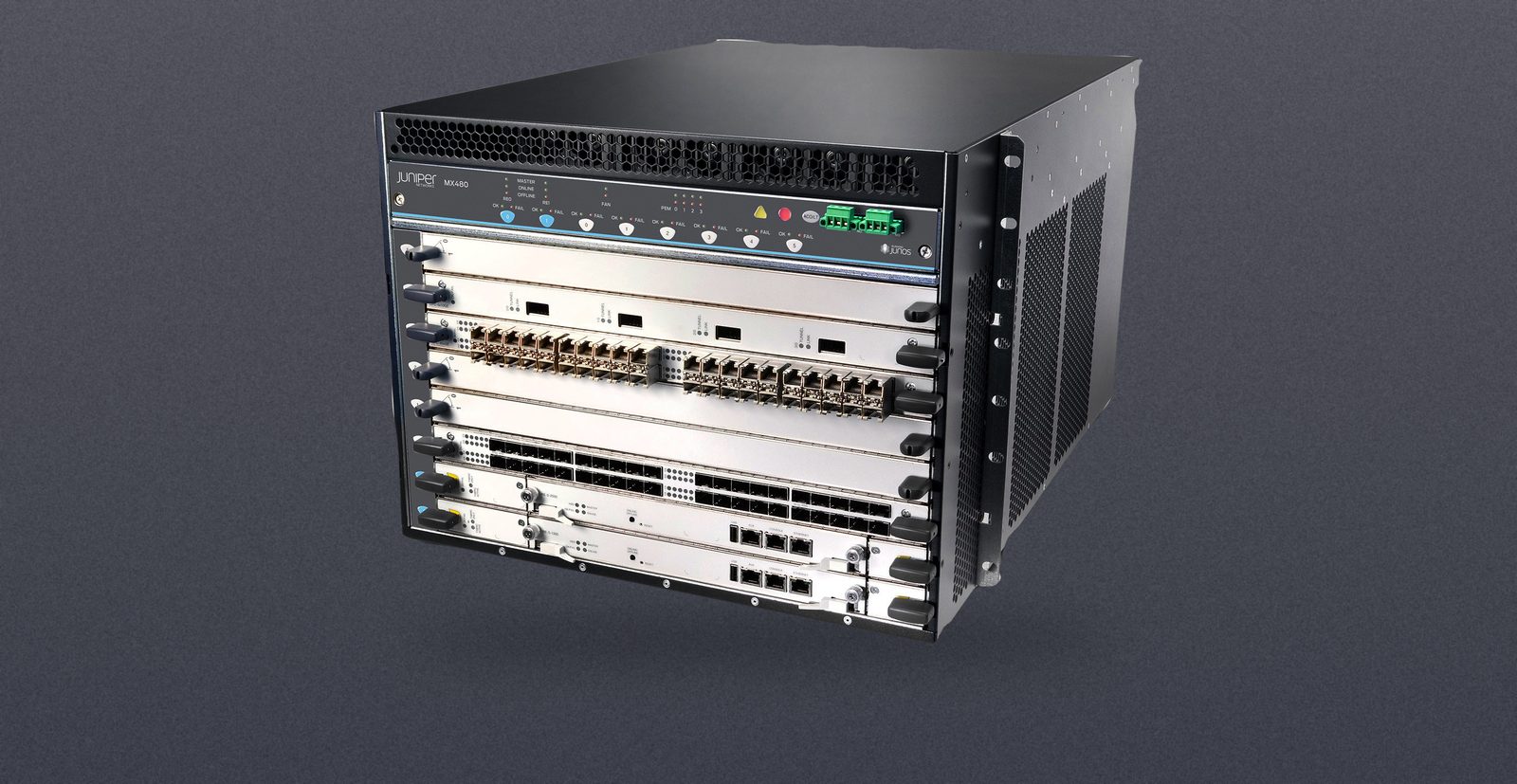
The MX480 is an 8 slot, 8U chassis with up to 5.76 Tbps of aggregate fabric. Juniper sells it as the MX480BASE, with 1 fan tray, 2 power supplies, 1 SCB and 1 Routing Engine, and as the MX480-PREMIUM2, with a redundant Routing Engine and SCBEs. The DC input of the MX480BASE-DC is -40.5 to -72 VDC (nominal -48 VDC).
The MX960 is 16U. The standard chassis is 27.75 x 17.37 x 23.0 in; with the extended cable manager (CHAS-BP-MX960-ECM-S) it is 36.5 in high, and up to two fit in a 48U rack. It cools front to back, with the intake at the front and the exhaust at the upper rear. AC power comes from PWR-MX960-AC-S supplies, 1700 W each and three per chassis, or from the high capacity PWR-MX960-4100-AC-S, 4100 W in two-feed mode and two per chassis. The CHAS-BP3-MX960-ECM-S carries the BP3 enhanced midplane, which cross-coupled SCBE2-MX clocking needs.
Line cards and Routing Engines
The three chassis share their line cards. The MX-MPC1E-3D and MX-MPC2E-3D have no fixed ports and 2 MIC slots each, for modules such as the MIC-3D-20GE-SFP (20 x 1GbE SFP) and the MIC-3D-4XGE-XFP (4 x 10GbE XFP). The MPC4E-3D-32XGE-SFPP carries 32 x 10GbE SFP+ at up to 260 Gbps, the MPC5EQ-100G10G carries 2 x 100GbE and 4 x 10GbE at up to 240 Gbps and needs an SCBE or SCBE2, the MPC7E-10G carries 40 x 10GbE, and the MPC10E-15C-MRATE runs at up to 1.5 Tbps on an enhanced midplane and 800 Gbps on a standard one.
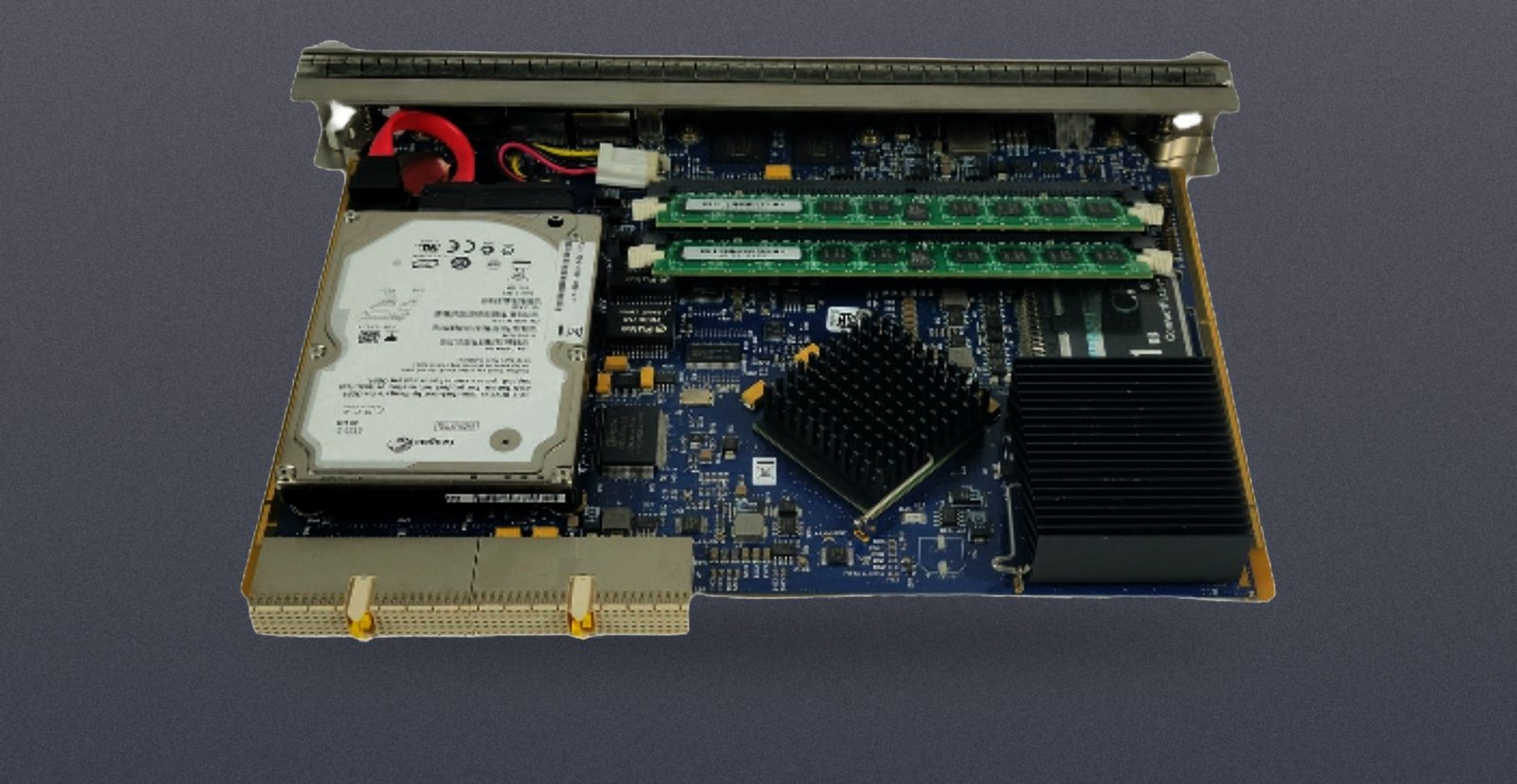
Routing Engines for the MX240, MX480 and MX960 run from the RE-S-1300-2048 (1.3 GHz CPU, 2 GB of memory) and the RE-S-2000-4096 (2 GHz, 4 GB) to the RE-S-X6-64G and RE-S-X6-128G (6 core 2.0 GHz CPU with 64 or 128 GB). The RE-S-X6-128G runs with SCBE2 or SCBE3 boards, and the SCBE3-MX gives up to 1.5 Tbps per slot with MPC10E cards.
What to check before you buy
- The license on an MX40 or MX80: the chassis is the same, and the license sets the ports and the capacity.
- The midplane of an MX240 or MX960: the BP3 enhanced midplane (CHAS-BP3) is needed for cross-coupled SCBE2-MX clocking, and the MPC10E-15C-MRATE reaches 1.5 Tbps only on an enhanced midplane.
- The control board a line card needs: the MPC5EQ-100G10G needs an SCBE or SCBE2, not the first SCB.
- The power feed: the MX104 takes 24, -48 or -60 VDC as well as AC, and the two MX960 AC supply types fit in different numbers per chassis.
- The airflow: the MX104 and MX240 cool side to side, and the MX960 front to back.
Lifecycle: what the dates mean
Juniper gives June 30, 2021 as the end of sale date for the MX40 and MX80 and June 30, 2026 as their end of support. For the MX104 bundles (MX104-MX5-AC, MX104-MX5-DC and MX104-80G-AC-BNDL) the end of sale date is March 15, 2023, with support to March 15, 2028. Among the line cards, the MX-MPC1E-3D, MX-MPC2E-3D and MIC-3D-20GE-SFP reached end of sale on June 30, 2021 and the MIC-3D-2XGE-XFP on January 17, 2024. Among the Routing Engines, the RE-S-1300-2048 reached it on October 31, 2015 and the RE-S-2000-4096 on May 1, 2016. End of sale is the last day to order a part new from Juniper; end of support is the last day Juniper takes a case on it.
Where to look
Each model has its own page listing what is in stock: the MX40, MX80, MX104, MX240, MX480 and MX960, with the MX line cards, the MX Routing Engines and the whole MX Series. Pages in stock today include the MX480 premium AC chassis, the MX240 base chassis, the MX80 AC router and the MX104 AC router. For the fixed MX204 and the modular MX304, read Juniper MX204 vs MX304; for the whole maker, the Juniper guide. Request a quote for a part that is not listed, or sell the routers you retire.
Sources
- Juniper MX5, MX10, MX40 and MX80 hardware guide
- Juniper MX40 specifications
- Juniper MX104 hardware guide
- Juniper MX240 hardware guide
- Juniper MX480 hardware guide
- Juniper MX960 hardware guide
- Juniper MX Series datasheet
- Juniper MX Series interface module reference
- Juniper end of life milestones, M and MX Series